
How to build regulatory trust: five questions every senior leader should ask
Regulatory trust isn’t won in a single ASIC meeting; it’s earned daily through accurate, timely, well-governed reporting. In James Dickson’s SIAA Monthly piece (Dec 2025, pp. 13–15), leaders are given a clear framework: ask sharper questions about ownership, causes, notifications, data architecture and independent assurance, then prove answers with evidence.
The five questions (and why they matter)
When something goes wrong, who owns it, and how quickly is it fixed?
Speed, accountable ownership and structured remediation signal maturity, not defensiveness.Are root causes fixed with complete back-reporting, or are symptoms just patched?
Regulators expect full-population analysis, historic corrections where needed, and proof the issue won’t recur.Do breach/incident reports genuinely enlighten ASIC?
Clear plain-English explanations, quantified impact, root-cause analysis, governance evidence and time-bound next steps build confidence.Is your data architecture strong enough for both daily reporting and long-term scrutiny?
End-to-end lineage, consistent definitions, sensible logic and robust change management are essential, especially when back-reporting is required.Is there independent, data-driven assurance, not just internal reassurance?
Full-population testing and external challenge reveal issues internal teams miss and give boards objective confidence.
What “good” looks like
Clear ownership and credible timelines for every material issue.
Root-cause remediation plus complete back-reporting where appropriate.
High-quality notifications that actually inform the regulator.
Strong data governance that supports accuracy today and scrutiny tomorrow.
Independent assurance to complement internal controls.
Bottom line
Trust is built through integration, not isolation: well-managed systems, sensible logic, strong governance, effective controls and active leadership - evidenced, not asserted.
Regulatory trust is earned daily, not in a single ASIC meeting. James Dickson sets out five questions leaders must ask to fix root causes, strengthen lineage and turn breach reporting into evidence of control (with links to the original SIAA article).

AI only works in broking when data is clean, governed and owned. James Dickson lays out six pillars and five quick actions leaders can take to deploy AI with confidence in SIAA Monthly (with links to the full article).

The Illusion of Assurance challenges the outdated view of Independent Reviews as routine compliance exercises, revealing how poorly scoped reviews can create risk rather than reduce it. As regulatory expectations intensify and counterparties demand proof of operational resilience, boards must shift from box-ticking to performance-tested assurance. Drawing on real-world case studies and regulatory findings, this article explains why review quality is now a commercial and governance imperative, and why documentation alone is no longer enough.
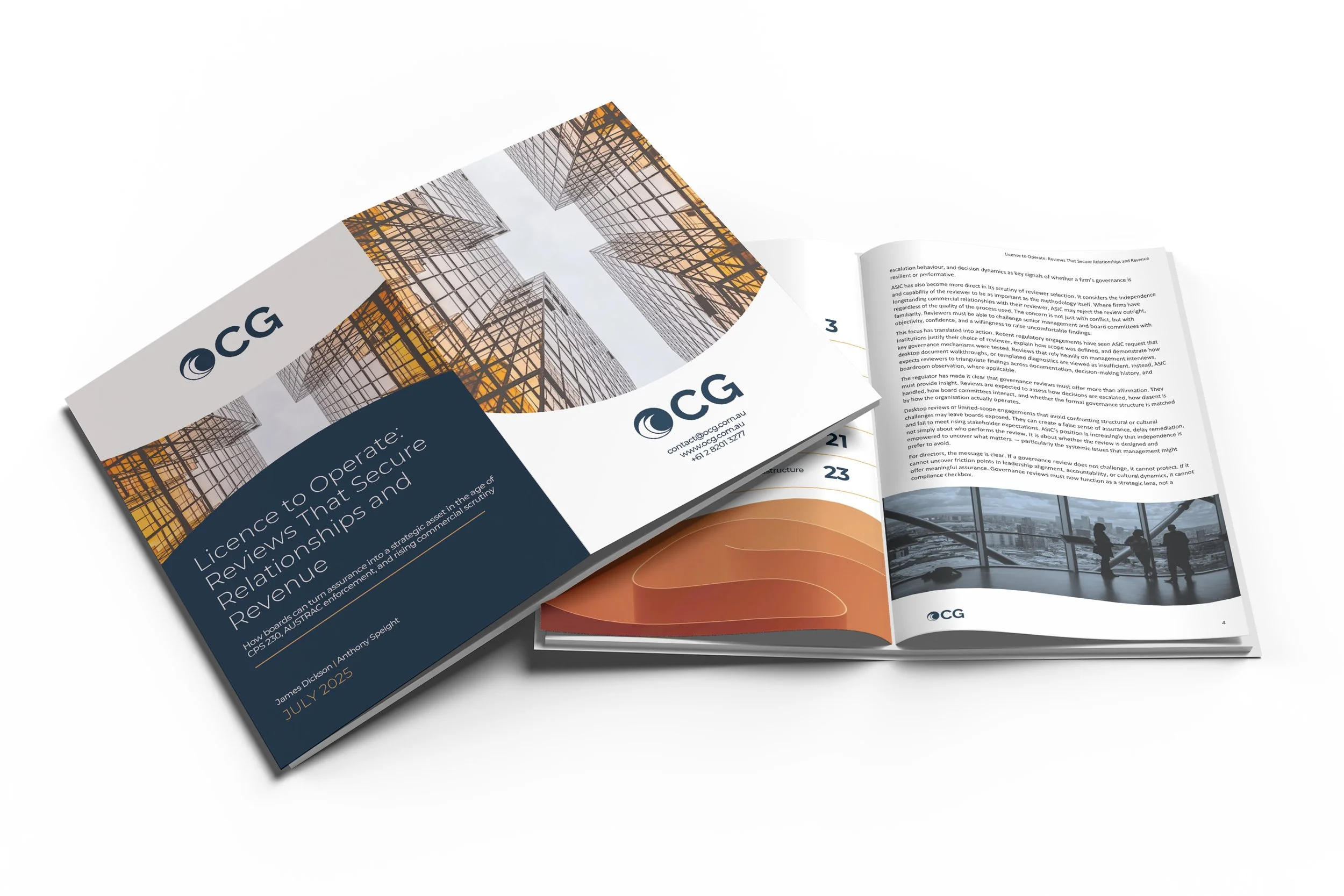
As regulatory expectations and commercial scrutiny intensify, the quality of independent reviews is no longer a compliance formality; it’s a measure of institutional maturity. This white paper explores how ASIC, AUSTRAC, and APRA are reshaping the review landscape, why superficial assessments are exposing boards to unnecessary risk, and how brokers, advisers, and financial service providers can respond with assurance that holds up under pressure.
Featuring real-world case studies and a practical framework for building substantive reviews, this paper is essential reading for directors, risk leaders, and regulated entities navigating CPS230 and beyond.

The partnership between Oceanic Consulting Group and DASH Technology Group introduces File Review as a Service (FRaaS) – a purpose-built solution that delivers independent, actionable insights into advice quality and compliance. Designed to support adviser performance, reduce compliance risk, and uplift customer outcomes, FRaaS empowers licensees to strengthen the advice lifecycle with targeted reviews and continuous improvement. By identifying opportunities for adviser training and enhancing client satisfaction, FRaaS drives trust, retention, and sustainable growth.

Following the Royal Commission, the financial services industry remains under scrutiny, and Oceanic Consulting Group (OCG) reveals that documentation, not the advice itself, is now the front line of compliance risk. After reviewing over a million advice files, OCG found that while most advice is sound, poor documentation renders up to 30% of files non-compliant. Missing links between fact finds, goals, and final recommendations create legal exposure and drive costly remediation. OCG’s File Review as a Service (FRaaS) helps firms tackle this challenge by embedding scalable review systems that strengthen documentation quality, support compliance, and reduce long-term risk.

In a rapidly evolving advice landscape, AI tools are transforming how Statements of Advice (SOAs) are generated, but that doesn’t eliminate the need for robust review. In their latest article, Anthony Speight and James Dickson of Oceanic Consulting Group (OCG) warn that while AI can speed up advice creation, advisers remain legally responsible for the accuracy and suitability of that advice. They advocate for quality input, clear client alignment, and independent oversight through OCG’s File Review as a Service (FRaaS), which provides human-led compliance support to ensure AI-generated advice meets both regulatory and ethical standards.

James Dickson, Managing Director of Oceanic Consulting Group (OCG), highlights the importance of peer reviewing Statements of Advice (SOAs) to ensure clarity and compliance.
Speaking at a recent industry conference, James emphasised the need for better workflows and more transparent communication to help clients understand the advice they receive.
Read the full article on Professional Planner.

Oceanic Consulting Group (OCG) and DASH Technology Group have partnered to launch File Review as a Service (FRaaS) - a scalable, independent solution designed to strengthen advice oversight and ensure compliance across the financial services sector. Available via DASH’s Advice Marketplace, FRaaS enables licensees to test advice quality, manage regulatory obligations, and reduce risk through targeted, high-impact reviews. Combining OCG’s deep advisory expertise with DASH’s innovative platform, this partnership delivers a flexible approach to uplift advice frameworks and support compliance maturity.

RecordPoint has announced a strategic partnership with Oceanic Consulting Group (OCG) to elevate information governance for financial institutions. Combining RecordPoint’s intelligent data management platform with OCG’s regulatory and operational expertise, the collaboration aims to help clients navigate growing compliance pressures, enhance records management, and future-proof their data governance strategies. This partnership enables smarter, scalable solutions tailored to the evolving needs of Australia’s financial services landscape.

Oceanic Consulting Group (OCG) has unveiled its newly redesigned website, www.ocg.com.au, developed in collaboration with Snowball Productions. The new platform reflects OCG’s commitment to digital innovation and client engagement, featuring streamlined navigation, responsive design, and enriched content tailored to the financial services sector. With a sharper focus on accessibility and strategic performance, the launch marks a significant step in strengthening OCG’s online presence and delivering greater value to clients.

A Guide highlighting the critical role of data maturity in the evolving financial services landscape. This article outlines a five-stage data maturity model, from Initial (Ad-Hoc) to Optimised (Innovative), emphasising how each stage impacts decision-making, compliance, and operational efficiency. The piece underscores the importance for stockbrokers to assess and enhance their data capabilities to meet regulatory requirements, leverage advanced analytics, and maintain a competitive edge in a data-driven market.

The AML/CTF Amendment Bill introduces critical reforms that raise the bar on financial crime prevention in Australia. With new requirements including a beneficial ownership register, enhanced due diligence, and expanded reporting obligations, wealth management firms must act now to update compliance programs, strengthen monitoring, and mitigate risk. This marks a key shift in regulatory expectations - one that demands immediate attention, smart strategy, and robust execution.

Oceanic Consulting Group (OCG) has merged with London-based LEAD Consulting, expanding its global footprint and enhancing its capabilities in marketing technology, customer data strategy, and financial services advisory. This strategic partnership strengthens OCG’s presence across Australia, the UK, Dubai, Hong Kong, and Singapore - uniting deep financial expertise with cutting-edge MarTech solutions to deliver client-centric, globally informed advisory services.

As ESG expectations accelerate, financial services firms must move beyond basic compliance to turn ESG complexity into strategic advantage. From governance and risk mitigation to advanced data management and regulatory readiness, this article explores how organisations can meet rising stakeholder and legislative demands, while positioning for growth. With expert insights and practical steps, OCG helps firms lead the way in sustainable transformation.

Oceanic Consulting Group (OCG) highlights the Australian Securities and Investments Commission's (ASIC) intensified focus on operational resilience within financial institutions. The piece identifies common shortcomings, such as the improper exclusion of critical services, overreliance on contingency plans, and inadequate documentation and oversight. OCG emphasises the necessity for firms to reassess and enhance their resilience strategies to align with ASIC's expectations, ensuring robust risk management and compliance frameworks are in place.

APRA's Prudential Standard CPS 230, effective from 1 July 2025, mandates that regulated entities enhance their operational risk management, business continuity planning, and third-party risk oversight. This standard aims to ensure entities can maintain critical operations during disruptions and manage risks associated with service providers. Key requirements include establishing a comprehensive risk management framework, implementing robust internal controls, and maintaining a credible business continuity plan. Boards and senior management are held accountable for overseeing these measures to ensure resilience and compliance.

This article examines the current criteria for classifying wholesale investors, focusing on the individual wealth test thresholds of $2.5 million in net assets or $250,000 in gross income over the past two years. It discusses the implications of these thresholds and the potential impact of proposed changes on investors and financial markets. The article also highlights the government's timeline for reviewing these classifications and the importance of aligning them with contemporary economic conditions.

This article discusses the Compensation Scheme of Last Resort (CSLR) and its role in maintaining trust within Australia's financial services sector. It highlights how the CSLR provides a safety net for consumers by ensuring compensation in cases where financial firms fail to meet their obligations. The article emphasises the importance of the CSLR in upholding the integrity of the industry and protecting consumers.

OCG emphasises the critical role of robust data management as wealth management firms expand into international markets. This article highlights the necessity for scalable data strategies to meet the demands of sophisticated clients and complex cross-border operations. The piece underscores the importance of aligning data infrastructure with regulatory requirements and operational needs to ensure seamless integration and informed decision-making in new market ventures.

Laksh Gangwani, APAC Managing Director for our partner ViewTrade, reflects on the recent trends in digital transformation across the financial services industry including markets businesses and fintech firms. The original video can be found here.
OCG introduces ViewTrade to its wholesale brokerage, wealth management and platform provider clients to address the inefficiencies they experience, powering cross-border investing for financial services firms throughout the world.